






Natural GLP-1: which foods and habits raise it, and why there is no ‘natural Ozempic’
The GLP-1 your gut makes rises with protein at the start of a meal, carbohydrates at the end and fermentable fibre. How much it rises according to the studies, why it lasts minutes compared with semaglutide's week, and what actually shifts weight.
Short answer
Natural GLP-1 is the hormone your gut makes when you eat. Protein at the start of a meal, carbohydrates at the end and fermentable fibre all raise it by a measurable amount. The effect is modest and brief: the body's own hormone lasts 2-3 minutes in the blood, whereas semaglutide lasts a week and circulates at concentrations around a thousand times higher. That is why there is no ‘natural Ozempic’.
Key points
- In a one-day trial in 15 people with type 2 diabetes, 50 g of whey protein before breakfast raised total GLP-1 by 141% and lowered blood glucose by 28% over three hours (Diabetologia, 2014).
- According to a meta-analysis of 17 studies in type 2 diabetes, leaving carbohydrates until last raises post-meal GLP-1 by an average of 8.21 pmol/L, but glycated haemoglobin (HbA1c) falls by only 0.16 points (Acta Diabetologica, 2026).
- According to a meta-analysis published in Sports Medicine (2014), a single exercise session raises GLP-1 by a median of 13%, a small effect that was not statistically significant.
- In the Look AHEAD trial, intensive diet and physical activity produced 8.6% weight loss at one year compared with 0.7%, and 6.0% compared with 3.5% after a median of 9.6 years (NEJM, 2013).
Habits that increase your own GLP-1: measured effect and study
Each study measures GLP-1 in its own way (as a percentage or in picomoles per litre), and almost always in the hours after eating. The figures therefore cannot be added together or compared with one another. What they show is that the effect exists and that it is modest.
| Habit | Measured effect on GLP-1 | Who was studied and for how long | Study |
|---|---|---|---|
| 50 g of whey protein before breakfast | +141% total GLP-1 (+298% intact GLP-1) | 15 people with type 2 diabetes, one day | Jakubowicz et al., Diabetologia 2014 |
| Carbohydrates at the end of the meal | +8.21 pmol/L after the meal | 389 people with type 2 diabetes, 17 studies | Saldarriaga-Callejas et al., Acta Diabetologica 2026 |
| 10 g/day of inulin-propionate ester | Short-term rise in GLP-1 and PYY | 60 adults with overweight, 24 weeks (weight) | Chambers et al., Gut 2015 |
| A single exercise session | +13% (median), not statistically significant | Meta-analysis of 20 studies, with GLP-1 measured in 5 | Schubert et al., Sports Medicine 2014 |
Natural GLP-1 is a hormone your gut makes every time you eat. Some habits raise it by a measurable amount: starting a meal with protein, leaving carbohydrates until last, eating fermentable fibre and, to a lesser extent, exercise. The rise is modest and lasts only minutes. That is why there is no such thing as a ‘natural Ozempic’: semaglutide works for a week and circulates at concentrations roughly a thousand times higher than the body's own hormone.
Below we cover what this hormone does, which foods and habits increase it according to the studies, by how much, and what actually shifts weight when it is measured over several years.
What is natural GLP-1 and what does it do?
GLP-1 (glucagon-like peptide-1) is a 30-amino-acid hormone produced by the intestinal L cells when food arrives. It does several things at once: it stimulates insulin release, holds back glucagon, slows gastric emptying (what physiologists call the ‘ileal brake’) and helps to regulate appetite, according to Jens Juul Holst's classic review in Physiological Reviews.
Its weak point is how long it lasts. An enzyme called DPP-4 breaks it down and inactivates it very quickly, even before it leaves the gut. The little that reaches the general circulation has a half-life of 2 to 3 minutes. It is a brief, local signal that food has arrived, not a lasting brake on hunger.
Why is there no ‘natural Ozempic’?
Medicines in this family mimic the hormone, but they are nothing like it in the two respects that matter for weight: how long it lasts and how much of it there is. The Spanish summary of product characteristics for Wegovy tablets, published by the AEMPS (Spain's medicines regulator), gives semaglutide a half-life of about one week, compared with the 2 or 3 minutes of the body's own GLP-1. It estimates that the drug remains in circulation for around seven weeks after the last dose.
The difference in quantity is even greater. Natural GLP-1 circulates in picomoles per litre. According to the US Food and Drug Administration label for Wegovy 25 mg tablets, semaglutide reaches average concentrations in nanomoles per litre: between 27 and 186 nmol/L in 90% of patients. That is around a thousand times more, and it stays that way day and night. A 2024 review describes these as supraphysiological doses. Eating one way or another produces small peaks after each meal, whereas the drug keeps the receptor activated all the time.
The ‘natural Ozempic’ label has mostly been attached to berberine, a plant extract sold as a food supplement. The most recent meta-analysis, covering 23 trials, credits it with an average loss of 0.88 kg compared with control. The OCU, Spain's consumers' organisation, advises against it. It causes digestive side effects, can lower blood pressure and blood glucose, and has documented interactions with up to 17 medicines. According to the organisation, ‘at present there is no solid scientific evidence’ that it is effective and safe for weight loss. The EU list of authorised health claims, Regulation 432/2012, contains none relating to GLP-1, satiety or berberine.
Which foods and habits raise GLP-1, and by how much?
Some habits produce measurable rises. For each study, it is worth checking who was measured, for how long and which outcome was followed. None of them is a regimen to copy. They describe what was observed in a specific group.
Protein at the start of the meal
In a crossover trial in 15 people with type 2 diabetes, taking 50 g of whey protein before a high-glycaemic-index breakfast increased total GLP-1 by 141% and intact GLP-1 by 298%. It also lowered post-meal glucose by 28% over the following three hours (Jakubowicz, Diabetologia 2014). This is the most striking effect on the list, but it was measured on a single day and weight was not tracked.
Carbohydrates last
There is now a meta-analysis on eating vegetables and protein first and leaving carbohydrates until the end, covering 17 studies and 389 people with type 2 diabetes. With that order, post-meal GLP-1 rose by an average of 8.21 pmol/L, glucose at 60 minutes fell by 42.7 mg/dL and gastric emptying was delayed by 28 minutes. Over the long term, however, glycated haemoglobin (HbA1c) fell by only 0.16 points. The effect on the glucose curve after each meal is large, but the effect on overall control is small.
Fermentable fibre
Bacteria in the colon ferment certain fibres and produce short-chain fatty acids such as propionate, which stimulate the L cells. In an Imperial College study published in Gut, researchers used an inulin-propionate ester, a compound they developed to deliver propionate to the colon. A 10 g daily dose increased post-meal GLP-1 and PYY and reduced how much people ate. Over 24 weeks, 60 adults with overweight who took it gained less weight than those taking inulin alone. The effect was less weight gain, not weight loss.
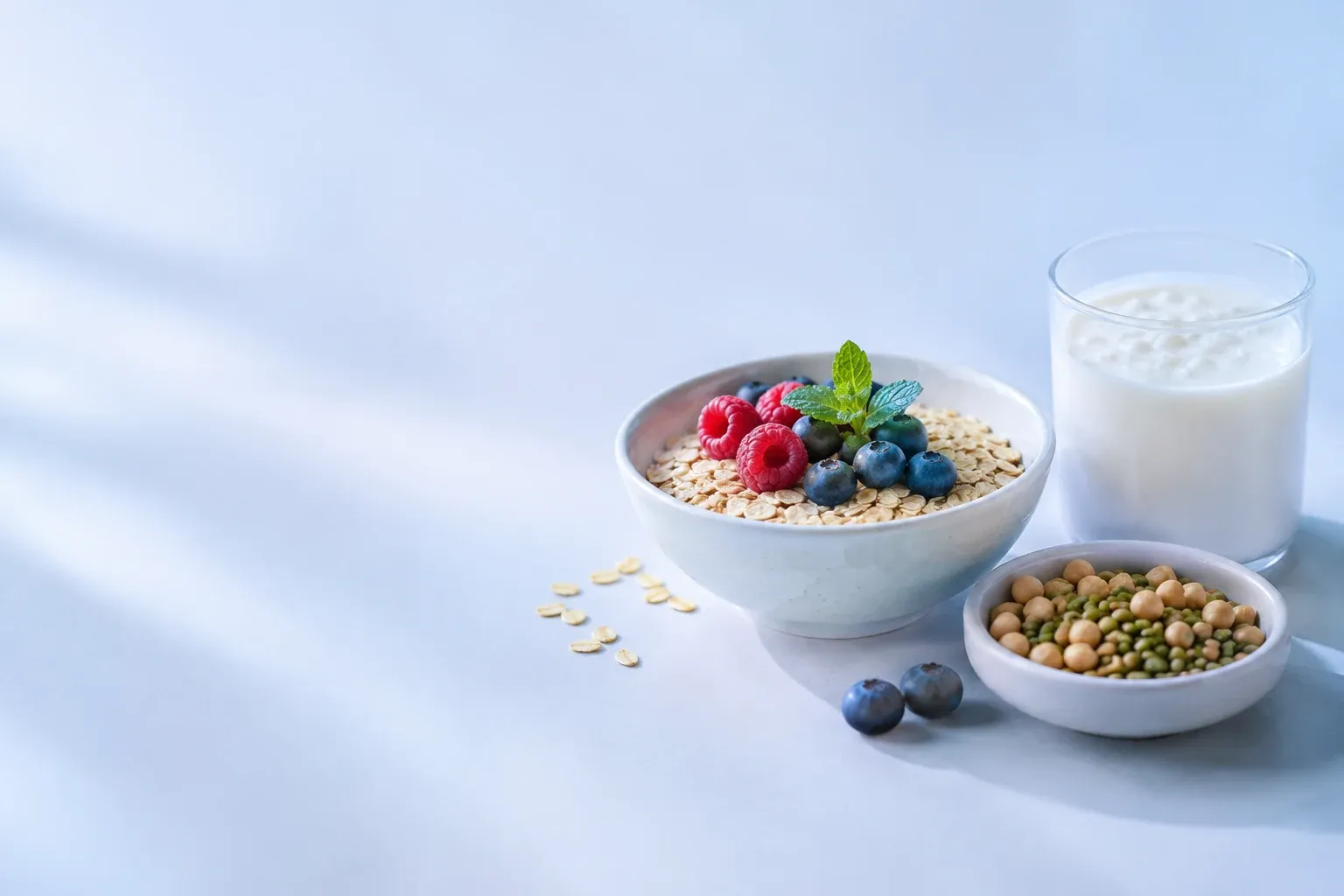
A 2026 review in the journal Nutrients puts three types of food in this group. The first is foods rich in fermentable substrates: fermented dairy, kefir, kimchi, oats, pulses, chicory, Jerusalem artichoke, garlic and onion. The second is polyphenols from berries, grapes and green tea. The third is omega-3 from oily fish. The authors themselves point out that the impact of modulating GLP-1 through diet is modest compared with activating its receptors with a drug.
Exercise
A single exercise session raises GLP-1 by a median of 13%, according to a meta-analysis of 20 studies with 241 participants. However, the GLP-1 figure comes from only five of those studies, and the effect was small and not statistically significant. Exercise is worthwhile for many reasons, but boosting this hormone is not the main one.
Does raising your own GLP-1 help you lose weight?
These studies measure the hormone and blood glucose in the hours after eating. Only one study on the list, the propionate fibre study, tracked weight over several months, and it found that people gained less weight, not that they lost any. Based on the data available, stimulating your own GLP-1 helps with glucose after each meal. It is not a weight-loss treatment.
It makes most sense for glucose control, and almost all the data come from people with type 2 diabetes. If you have been told your blood glucose is high or that you are heading towards diabetes, these are details worth discussing with your doctor. Here we explain what prediabetes is and how it is managed and how insulin resistance is diagnosed and reversed.
What actually helps with weight loss, according to the evidence?
When measured over several years, what shifts weight is consistently eating less energy and moving more. The Look AHEAD trial included 5,145 adults with type 2 diabetes and overweight or obesity. They were assigned either to an intensive diet and physical activity programme or to diabetes education. At one year, the intensive group had lost 8.6% of their body weight compared with 0.7% in the education group. At the end of the trial, after a median follow-up of 9.6 years, the figures were 6.0% and 3.5%. The programme did not reduce cardiovascular events, which was its primary goal. However, it lowered HbA1c more, and it initially improved fitness and almost all risk factors.
This gives us two lessons. First, habits work, and the biggest effect comes early. Second, the effect is hard to keep up, and the gap narrows over the years. That is why trials of weight-loss medicines always build on a foundation of diet and physical activity. In the OASIS 4 trial, all participants followed a reduced-calorie diet and increased their physical activity. Over 64 weeks, those on placebo lost 2.2% of their body weight and those on oral semaglutide lost 13.6%. We explain how these drugs work and who can take them in our guide to Ozempic in Spain.
If you are interested in medicines that act on GLP-1, our guide to prescription weight-loss pills summarises which ones have evidence behind them and how to access them in Spain.
What if habits are not enough?
The key point to remember: you can stimulate the hormone your gut makes by eating protein first, carbohydrates last and plenty of fermentable fibre. That helps with your glucose after each meal, but it does not mimic a medicine or replace a weight-management plan.
If you have been looking after your diet and activity for a while and your weight is not changing, AiON offers a medical weight-loss programme. It includes an initial assessment, a prescription from a registered doctor where appropriate, and ongoing follow-up. You can:
Sources
- Holst JJ. The physiology of glucagon-like peptide 1. Physiol Rev 2007
- Tkaczenko H et al. Foods as Modulators of GLP-1 Secretion. Nutrients 2026
- Saldarriaga-Callejas LM et al. Nutrient intake order on metabolic outcomes in type 2 diabetes. Acta Diabetol 2026
- Jakubowicz D et al. Incretin, insulinotropic and glucose-lowering effects of whey protein pre-load in type 2 diabetes. Diabetologia 2014
- CIMA AEMPS, ficha técnica de Wegovy comprimidos
- Look AHEAD Research Group. Cardiovascular effects of intensive lifestyle intervention in type 2 diabetes. N Engl J Med 2013
It's time to reach your goal.
Online medical assessment, prescription when appropriate and 1:1 follow-up with this team.
Frequently asked questions
- Is berberine a natural Ozempic?
No. The most recent meta-analysis, covering 23 trials, credits it with an average loss of 0.88 kg compared with control, which is a long way from what a medicine achieves. The OCU, Spain's consumers' organisation, advises against it because of its side effects and its documented interactions with up to 17 medicines. It considers that there is no solid evidence that berberine is effective and safe for weight loss.
- Are there any supplements that increase GLP-1?
In the European Union, which includes Spain, no supplement is allowed to claim that it increases GLP-1 or satiety. Regulation 432/2012, the list of authorised health claims, does not include any such claim. The closest is glucomannan, which may claim to contribute to weight loss, but only as part of a reduced-calorie diet.
- Does eating carbs last help if I don't have diabetes?
This has not been properly measured. The meta-analysis that found a rise in GLP-1 and a fall in post-meal glucose was carried out in people with type 2 diabetes, and its long-term effect on glucose control was small. The sources we reviewed contain no equivalent data for people without diabetes.
- How much weight do you lose on a GLP-1 medicine compared with diet alone?
In the OASIS 4 trial, all participants followed a diet and increased their physical activity. Over 64 weeks, oral semaglutide produced an average loss of 13.6% of body weight, compared with 2.2% on placebo. In the Look AHEAD trial, intensive lifestyle changes without medication produced an 8.6% loss at one year, which fell to 6.0% after about nine and a half years.